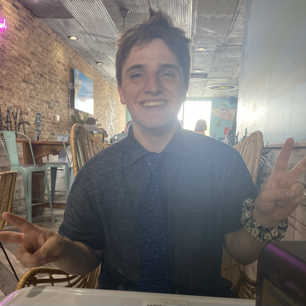
About Me
I’m Patrick Dugan, a student at the University of Pennsylvania in the submatriculation program: an M.S.E. and B.S.E. in Computer Science and a B.A. in Mathematics, expected December 2027. I work on AI, usually with a proof and a prototype going at the same time. This summer at Concurrent EDA I built an LLM agent that designs FPGA hardware from C code, along with the benchmark used to evaluate it, and the prototype was chosen for production. On my own I’m building neural networks that compile down to logic circuits, so what they learn can be checked exactly. (Resume, PDF)
Selected work
- LLM agent for FPGA design (Concurrent EDA, summer 2026). I pitched it and built it solo: C code in, optimized hardware designs out, with a 100+ task benchmark. 16× fewer tokens than an unassisted LLM, synthesizable output from 80% to 100%, and chosen for production.
- Ambi, a neurosymbolic loophole finder for policies. LLMs turn rules into fuzzy logic and an exact solver searches for what they allow but shouldn’t. 360/360 known loopholes found with 0 false positives on a public benchmark.
- Logic gate networks that compile to exact circuits, with a GF(2) solver for where gradient descent fails.
Research
Sign patterns and root bounds. My preprint Sign Patterns of Möbius Functions and Positivity of Shifted Chain and Walk Polynomials proves that every finite graded poset has all the real roots of its chain polynomial in [−4, 0]. The usual tools for bounds like this are topological (shellability, Cohen–Macaulayness, h-vectors), and graded posets need not satisfy them. The paper uses a sign pattern of the Möbius function instead: when (I + aA)⁻¹ alternates in sign along a 2-coloring, every walk-counting polynomial has its real roots in [−a, 0]. It also works out exactly when that pattern holds, with optimal constants, and applies the result to numerical semigroups. Preprint, revised November 2026. (PDF · watch the theorem run live)
Playground
Small interactive pieces from my research and writing. Hover to preview; click through to play with the full version.
Current interests
- LLM agents: building agents that use tools well, and evaluating them honestly. My Concurrent EDA agent took C code to optimized hardware designs.
- Neurosymbolic AI: models whose outputs can be verified. Logic gate networks that compile to exact circuits, and C2NN, a compiler that turns C programs into neural networks.
- AI safety and rule-following: getting models to obey rules exactly, and finding where rules can be gamed (Ambi, a loophole finder for policies).
- Learning theory and combinatorics: the PAC model, VC dimension, and sample complexity (I’m in Theory of Machine Learning with Michael Kearns this fall), plus real-rootedness and Möbius functions on posets.
Elsewhere
I TA CIS 1600 (discrete math) at Penn. I was an AI engineering intern at Concurrent EDA (summer 2026), a machine learning engineer at Palm Cosmetics (computer vision, Dec 2025 – Jan 2026), and a data science research intern in CMU’s REUSE program (summer 2025). The blog has older writeups, mostly mathematical oddities from high school onward.
Full details are on my CV, or grab the one-page resume (PDF).